
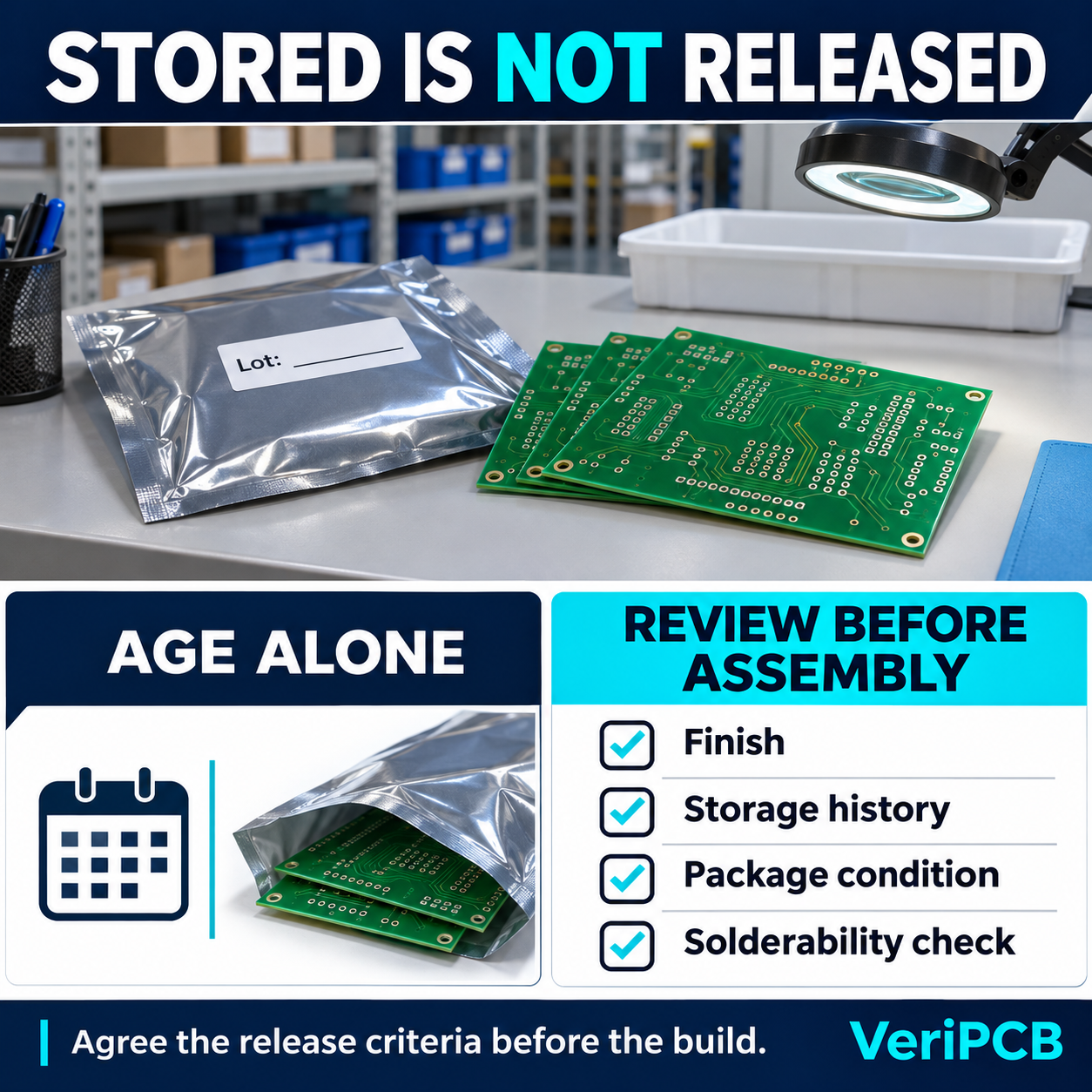
Why stored PCB stock can disrupt an assembly plan
Having the right quantity in stock is reassuring when a production slot is approaching. An unresolved material question at that point can leave purchasing, quality and production chasing the same missing information. A short review before line allocation gives the team a clearer decision and an owner for any exception.
For this guide, PCB means an unpopulated printed circuit board. The review below is a recommended decision process, not a report of a VeriPCB customer failure, measured improvement or standard acceptance service. Component floor life and assembled-board handling require separate controls.
How surface finish and storage affect solderability
Surface finish helps protect exposed pads from oxidation and contamination. Finish selection should take account of storage and assembly handling, as explained in Eurocircuits’ surface-finish guidance. That is a general technical principle; its products and service terms do not define VeriPCB’s offering.
Ask which finish was actually supplied and which storage instructions apply to that order. Do not transfer one supplier’s stated storage period to another supplier or finish. Manufacturing date, receipt date and bag-opening date describe different events. An intact-looking outer carton does not establish the condition or exposure history of the boards inside.
A stored-PCB release checklist for EMS teams
Use the following comparison to plan evidence and responsibilities. The right column describes a proposed control state, not a verified before-and-after result or a promise that every operation is included in a VeriPCB order.
| Decision dimension | Common gap | Proposed control and evidence |
|---|---|---|
| Lot and revision | Stock quantity is known; lot or revision is unclear. | Match board revision, finish and manufacturing lot to the material record. |
| Dates | Receipt date is treated as the complete storage history. | Separate manufacturing, receipt, opening and resealing events; identify missing records. |
| Finish instructions | One shelf-life assumption is used for every finish. | Use the actual fabricator’s applicable instructions; agree any extension or exception. |
| Packaging | Only the outer carton is checked. | Review inner package condition, seal integrity and known handling events. |
| Environment | Unknown storage conditions are assumed acceptable. | Review available exposure records against order requirements; flag gaps for engineering. |
| Solderability evidence | An appearance check is treated as proof of wetting. | Agree representative samples, assessment method, acceptance criteria and result scope. |
| Drying | A universal oven cycle is treated as release approval. | Confirm whether drying is needed and validate a board-specific process with the responsible parties. |
| Disposition | Questions are carried into the line without an owner. | Record hold, further assessment or release, with the evidence, approver and conditions. |
Numerical limits belong in the project specification: sample quantity, exposure limits, handling conditions and any drying parameters. This guide sets no universal temperature, duration, shelf life or guaranteed yield.
When is a solderability assessment useful?
Consider an assessment when records are incomplete, storage instructions may not have been followed, packaging is compromised or a trial raises a wetting concern. These are prompts for review, not automatic proof that the PCB is defective. Agree which lot and locations the samples represent, the method, any preconditioning, the acceptance criteria and who will approve disposition.
Retain the result with its sample identity and limitations. Passing selected samples supports the agreed decision; it does not establish the condition of every pad on every board. If soldering difficulties appear during assembly, investigate the complete process before assigning a root cause to storage. Paste, flux, component terminations and process conditions may also need review.
Does baking restore PCB solderability?
Do not treat baking as automatic proof of solderability. Moisture management and pad wetting are different questions. In section 5.5 of its Technical Delivery Specification for PCBs, Würth Elektronik explains that drying parameters depend on the board design, material, equipment, loading and soldering process and must be determined and verified by the assembler. These are that manufacturer’s instructions, not a VeriPCB drying recipe.
If a review identifies a drying need, confirm the applicable process with the fabricator and assembler. Record the handling and waiting conditions after treatment as well as the drying step. Resolve any separate solderability concern using the agreed evidence and disposition process.
What to record before releasing stored boards
- Identify the board revision, lot, finish and available quantity.
- Attach applicable storage and handling instructions, with known exposure or packaging exceptions.
- Agree any assessment, sample scope and acceptance criteria before work starts.
- Assign the engineering disposition owner and record the evidence reviewed.
- State any release conditions, packaging instructions and waiting limits.
- Update the production plan after the material decision, keeping planned and confirmed dates separate.
A useful record can be a short table with lot, issue, evidence, action owner, disposition, approval date and conditions. Its purpose is to make the next handoff understandable. It is not a substitute for the acceptance plan agreed for the product.
Common questions about stored bare PCBs
How long can bare PCBs be stored before assembly?
There is no single period set by this guide. Review the actual finish, packaging, storage history and fabricator’s applicable instructions. Ask the responsible engineering team to resolve uncertainty before release.
Is a visual inspection enough to approve stored PCBs?
Appearance is one input. It does not by itself establish solderability or the complete exposure history. Agree any additional assessment and its acceptance criteria according to the project risk.
Should every stored PCB batch be baked?
No universal baking instruction is given here. Determine whether drying is needed and agree a compatible, verified process for the board and assembly route. Drying does not replace the solderability decision.
Start the discussion without sharing confidential files
If you are weighing a build decision, a short summary is enough to begin: board finish, lot or approximate age, quantity, known storage conditions and the next assembly step. Contact andy@reach.veripcb.com or use the project enquiry form. Agree an NDA or suitable private transfer method before sending confidential drawings or other restricted information.
Have stored boards and an approaching build?
You are welcome to start with a non-confidential description of the surface finish, quantity, storage history and intended assembly date. We can discuss the information needed for a project review; assessment scope, cost and timing require agreement. We provide both PCB manufacturing and PCBA assembly services.
Discuss my PCB project